


Views: 0 Author: Site Editor Publish Time: 2026-08-10 Origin: Site


Food processing wastewater can contain a mixture of fats, oils and grease (FOG), suspended solids, proteins, starch, sugars, fibers and dissolved organic matter.
The right treatment process depends on what the wastewater contains and how those pollutants behave.
Some contaminants, such as meat particles, fibers and suspended starch, can often be removed through physical or chemical separation. Others, including dissolved sugars, lactose and soluble organic compounds, usually require biological treatment.
This is why effective food processing wastewater treatment normally combines several stages rather than relying on one piece of equipment.
A typical treatment process may include:
Screening → Equalization → Coagulation & Flocculation → Dissolved Air Flotation → Biological Treatment → Sludge Dewatering
Dissolved air flotation is particularly useful when wastewater contains high levels of FOG, fine suspended solids or chemically formed flocs.
Biological treatment becomes more important when the remaining pollutant load is mainly dissolved and biodegradable.
The first step is therefore to understand whether the main problem is suspended solids, FOG, dissolved COD, or a combination of all three.
Table of Contents
Food processing wastewater varies widely between industries.
A poultry plant, dairy factory and brewery may all produce high-strength wastewater, but the pollutant composition can be very different.
Food Industry | Common Wastewater Characteristics | Main Treatment Concern |
|---|---|---|
Meat and poultry | Blood, fat, proteins, feathers, meat particles | FOG, TSS and COD |
Dairy | Milk fat, proteins, lactose, cleaning chemicals | FOG and dissolved COD |
Seafood | Fat, proteins, scales and fine solids | FOG, TSS and organic load |
Fruit and vegetable | Soil, pulp, fibers and sugars | TSS and biodegradable COD |
Potato and starch processing | Starch, soil, fibers | High TSS and COD |
Brewery | Yeast, sugars, spent grain, variable pH | High biodegradable COD |
Bakery | Flour, oils, sugar and product loss | COD and suspended solids |
Beverage production | Sugars, syrups and cleaning water | Dissolved COD |
Prepared foods | Fats, sauces, proteins and solids | Mixed FOG, TSS and COD |
This variation means treatment equipment should not be selected from industry averages alone.
Wastewater should be evaluated under actual production conditions.
The composition may also change during:
Production shifts
Product changeovers
Cleaning cycles
CIP operations
Seasonal production
Startup and shutdown periods
These changes can affect flow, COD, FOG, pH and suspended solids.
These three parameters are often discussed together, but they do not represent the same type of pollution.
FOG includes fats, oils and grease released during food processing.
Common sources include:
Meat fat
Poultry fat
Dairy fat
Cooking oil
Sauces
Seafood oil
Some free-floating oil can be separated relatively easily.
Fine or emulsified fat droplets can be more difficult to remove and may require chemical conditioning before flotation.
Total suspended solids may include:
Meat particles
Fibers
Starch
Protein solids
Soil
Vegetable matter
Yeast
Fine food residues
These materials can increase sludge production and place unnecessary loading on downstream biological treatment if they are not removed early.
COD measures the total oxidizable load in the wastewater.
Some COD is associated with suspended material.
For example:
Fat droplets
Starch particles
Meat solids
Protein flocs
This portion may be reduced when solids are removed.
Other COD remains dissolved.
Examples include:
Sugars
Lactose
Dissolved proteins
Organic acids
Soluble starch
Beverage ingredients
This dissolved fraction cannot simply be screened or floated out.
Suspended solids and FOG → remove physically where practical.
Dissolved biodegradable COD → treat biologically.
High FOG + high TSS + high COD → combine primary separation with biological treatment.
This distinction is one of the most important steps in food wastewater treatment design.
Good treatment design starts with representative data.
A single sample taken during stable production may not show the actual loading that occurs during washdown or product loss.
Useful parameters include:
Measure:
Average flow
Peak flow
Operating hours
Batch discharge conditions
Peak flow can be especially important in food plants because cleaning cycles often create short periods of high wastewater generation.
COD shows total oxidizable loading.
BOD provides additional information about the biodegradable portion of the organic load.
The relationship between the two can help determine how important biological treatment will be.
High TSS may indicate that primary solids removal should be prioritized.
FOG is particularly important in:
Meat
Poultry
Dairy
Seafood
Prepared foods
The form of the oil also matters.
Free oil and emulsified oil do not always behave the same way during separation.
pH can change because of:
Cleaning chemicals
CIP systems
Raw materials
Production additives
Large pH fluctuations may affect both chemical and biological treatment.
Warm wastewater can affect flotation, biological activity and equipment selection.
The treatment system should reflect how the factory actually operates.
A plant running continuously may need a different design from a plant with several large batch discharges each day.

There is no universal treatment line for every food plant.
However, many systems follow the same basic logic:
Remove large solids → stabilize the wastewater → separate FOG and fine solids → treat dissolved organic matter → handle the resulting sludge.
Screening is usually the first stage.
Its purpose is to remove material that should not enter pumps, tanks, flotation systems or biological reactors.
Depending on the food industry, screens may remove:
Meat pieces
Feathers
Vegetable fibers
Seeds
Peels
Spent grain
Large starch residues
Packaging debris
The appropriate screen opening depends on the size and type of solids.
Very fine screens may improve solids recovery but can also require more frequent cleaning.
The goal is not to capture every small particle at this stage.
It is to remove the material that can be separated efficiently before more advanced treatment.
Food processing wastewater can change quickly.
A factory may produce relatively stable wastewater for several hours and then begin a cleaning cycle.
During that period:
Flow increases
pH may shift
COD can rise
FOG concentration may change
Chemical residues may enter the system
An equalization tank helps smooth these fluctuations.
Its purpose is to create a more consistent feed for downstream treatment.
Mixing is usually important to prevent solids from settling unevenly inside the tank.
Equalization can also make:
Chemical dosing easier
Flotation more stable
Biological loading more predictable
Tank size should be based on actual production and flow variation rather than a fixed retention time copied from another plant.
Fine suspended particles and emulsified fats may not separate well on their own.
Chemical conditioning can help.
A coagulant destabilizes fine particles and emulsions.
A flocculant helps those particles combine into larger flocs.
These flocs can then be separated more effectively by flotation.
Chemical dosing may be useful for:
Fine protein solids
Emulsified fats
Starch particles
Colloidal material
Fine organic solids
The correct chemical program depends on the wastewater.
Important variables include:
pH
FOG
TSS
Temperature
Protein content
Cleaning chemicals
Production additives
Jar testing is useful when establishing an initial dose.
The objective is not simply to use enough chemical to produce visually clear water.
Chemical cost, sludge volume and operating stability should also be considered.
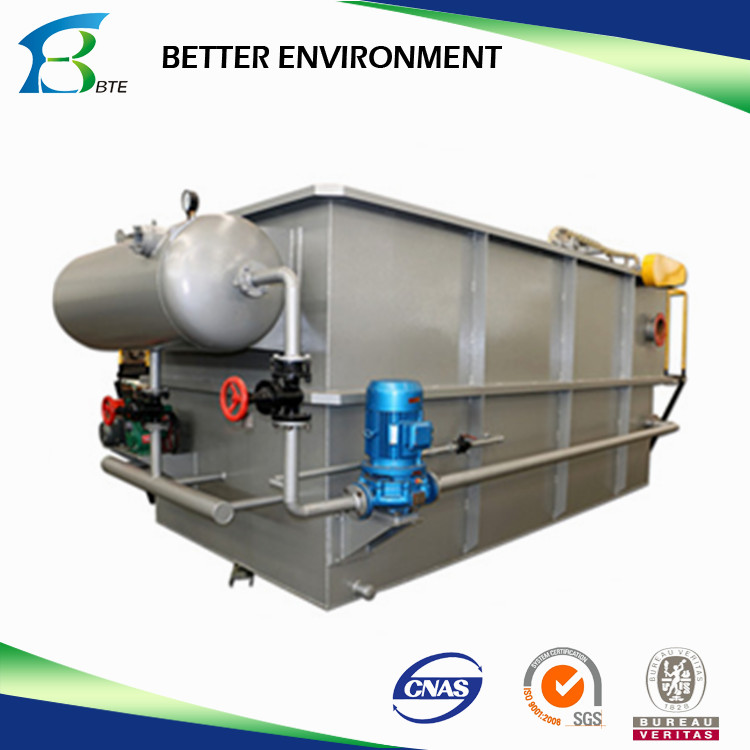
Dissolved air flotation is widely used in food processing wastewater when the influent contains light suspended solids, fine FOG or chemically formed flocs.
A DAF system introduces fine bubbles into the wastewater.
These bubbles interact with particles and flocs and help carry them to the surface.
A mechanical scraper then removes the floated sludge.
For food wastewater, DAF can be especially useful for removing:
FOG
Fine meat particles
Protein solids
Suspended starch
Fibers
Chemically formed flocs
Particulate COD
A Dissolved Air Flotation Machine is often used as a primary treatment step before biological treatment.
Its job is to reduce the suspended and floatable load.
It should not be expected to remove all dissolved COD.
After primary separation, wastewater may still contain significant dissolved BOD and COD.
This is where biological treatment becomes important.
Common technologies include:
Activated sludge
MBBR
MBR
SBR
Anaerobic reactors
Combined anaerobic and aerobic treatment
The correct process depends on:
Organic load
Biodegradability
Available space
Discharge requirements
Energy consumption
Operator experience
Aerobic systems use oxygen to support microorganisms that break down biodegradable organic matter.
They are commonly used for moderate-strength wastewater or as a polishing stage after anaerobic treatment.
Anaerobic treatment may be considered for higher-strength biodegradable wastewater.
It can reduce organic loading while producing biogas.
This can be relevant for industries such as:
Brewery
Starch
Beverage
Dairy
High-strength food processing
However, anaerobic treatment is not automatically suitable for every plant.
Stable performance depends on wastewater composition, loading, pH, temperature and nutrient balance.
Primary and biological treatment both produce sludge.
DAF sludge may contain:
Fat
Protein
Food solids
Fibers
Chemical flocs
Water
Biological treatment creates additional biological sludge.
This material often needs to be thickened and dewatered before disposal or further handling.
Possible equipment includes:
Screw press
Filter press
Belt press
Centrifuge
Other sludge dewatering systems
A Sludge Dewatering Machine should therefore be considered as part of the treatment system rather than as a separate problem after commissioning.
DAF is most suitable when a large portion of the wastewater load is suspended, floatable or can be converted into flocs.
Typical conditions include:
Common in:
Meat processing
Poultry
Dairy
Seafood
Prepared foods
Fine fat droplets may remain suspended and respond well to flotation, especially after proper chemical conditioning.
DAF can help remove:
Protein particles
Starch
Fibers
Fine food residues
Some organic solids are too light to settle efficiently in a conventional gravity separator.
Flotation may provide a better separation mechanism in these cases.
Coagulation and flocculation can create larger flocs that are suitable for flotation.
DAF is often used to reduce the amount of FOG and suspended solids entering the biological system.
This allows the biological stage to focus more on dissolved biodegradable pollution.
Different food sectors tend to have different wastewater priorities.
Application | Recommended Treatment Focus |
|---|---|
Meat / Poultry | Screening → Coagulation → DAF → Biological |
Dairy | Equalization → DAF → Biological |
Seafood | Screening → DAF → Biological |
Potato / Starch | Screening → DAF → Anaerobic/Aerobic |
Brewery | Screening → Equalization → Biological |
Beverage | Equalization → Biological |
Fruit / Vegetable | Screening → Equalization → Biological |
Bakery | Screening → DAF or Biological depending on solids |
High-FOG wastewater | Coagulation → DAF |
High dissolved COD | Biological treatment |
This is a general guide.
Actual design should always be based on site-specific wastewater data.
Both technologies can be useful.
The correct choice depends on how the pollutants behave.
Gravity separation may work well for:
Free-floating oil
Large oil droplets
Easily settling solids
Coarse material
It can be simple and effective when pollutants separate naturally.
DAF is more commonly considered when wastewater contains:
Fine FOG droplets
Emulsified oil after chemical conditioning
Fine suspended solids
Light organic particles
Chemically formed flocs
The choice should not be based on one technology being universally better.
It should be based on the pollutant characteristics.
Clarifiers are useful when solids settle effectively.
They can perform well for:
Biological sludge
Dense suspended solids
Settling flocs
However, food wastewater often contains light solids and FOG that do not settle efficiently.
In those situations, DAF may be more suitable as a primary separator.
The two technologies may also be used in different parts of the same treatment plant.
For example:
DAF → Biological Treatment → Secondary Clarifier
Each stage performs a different function.
DAF selection should consider more than total flow.
Important factors include:
The system must handle both average and peak flow conditions.
TSS and FOG concentration affect flotation performance and sludge production.
The performance of DAF may depend heavily on:
Coagulant selection
Polymer selection
Mixing
pH
The system should be able to remove floated sludge without allowing excessive accumulation.
Stable bubble production is important for effective flotation.
Construction material should reflect the wastewater environment.
Options may include:
Stainless steel
Coated carbon steel
Other corrosion-resistant materials
The correct choice depends on:
Chloride
pH
Cleaning chemicals
Outdoor exposure
Required equipment life
No single material is automatically correct for every food plant.
DAF and biological treatment should not be viewed as competing technologies.
They solve different problems.
DAF removes:
FOG
TSS
Particulate COD
Chemical flocs
Biological treatment handles more of the:
Dissolved BOD
Dissolved COD
Biodegradable organic matter
For many food processing plants, the most effective approach is:
Primary separation first, biological treatment second.
This can reduce unnecessary solids loading on the biological system.
Food processing plants increasingly evaluate treated-water reuse.
However, reuse requirements depend on where the water will be used.
Possible applications may include:
Cooling
Utility water
Landscape irrigation
Non-product-contact cleaning
Selected process applications
Additional treatment may include:
Sand filtration
Multimedia filtration
Activated carbon
Ultrafiltration
Reverse osmosis
Disinfection
Water used near food-contact surfaces may require significantly stricter treatment and hygiene control than general utility water.
Reuse design should therefore follow local food-safety and water-quality requirements.
Equipment purchase price is only one part of the total cost.
A better comparison includes:
Equipment cost
Chemicals
Electricity
Labor
Maintenance
Sludge disposal
Sewer discharge charges
Water reuse savings
Replacement parts
A low-cost treatment system may become expensive if it consumes excessive chemicals or generates difficult sludge.
Likewise, a more advanced system may be justified if it reduces long-term discharge or disposal costs.
The decision should be based on lifecycle cost rather than equipment price alone.
COD does not show whether pollution is suspended or dissolved.
This distinction affects the treatment process.
Large food solids can clog pumps and increase downstream load.
Cleaning and CIP periods may produce much higher flow than normal production.
Large FOG loads should be removed early where practical.
DAF removes suspended and floatable pollutants.
Dissolved COD generally remains.
More coagulant and polymer does not always improve treatment.
Excess dosing increases cost and sludge.
DAF may generate a significant amount of wet sludge.
Handling and disposal should be included in the original design.
Flow is only one design parameter.
FOG, TSS, COD, pH and wastewater variation are equally important.
Food production releases organic materials such as fat, protein, starch, sugar and product residues into wastewater.
Both suspended and dissolved organic matter contribute to COD.
The best method depends on whether the FOG is free-floating, dispersed or emulsified.
Gravity separation can work for easily separated oil, while DAF is often considered for finer droplets and chemically conditioned emulsions.
Yes, when part of the COD is associated with suspended or floated solids.
It does not remove all dissolved COD.
No.
It depends on wastewater strength and discharge requirements.
However, when significant dissolved biodegradable BOD or COD remains, biological treatment is commonly needed.
It can be useful for removing milk fat, suspended protein and other floatable material before biological treatment.
Yes, it is commonly considered when wastewater contains high levels of FOG, meat particles, proteins and fine suspended solids.
Potentially.
The required polishing treatment depends on the intended use and applicable food-safety regulations.
Useful information includes:
Average flow
Peak flow
COD
BOD
TSS
FOG
pH
Temperature
Production schedule
Cleaning cycle
Required discharge quality
Available installation space
Effective food processing wastewater treatment starts with identifying which pollutants are suspended, floatable or dissolved.
Screening removes coarse food solids. Coagulation and flocculation help separate fine particles and emulsified FOG. Dissolved air flotation can reduce fats, suspended solids and particulate COD, while biological treatment handles more of the remaining dissolved organic load.
For many food plants, the most practical treatment train is therefore a combination of primary solids removal, DAF, biological treatment and sludge dewatering.
Shandong Better Environmental Protection Technology Co., Ltd. provides wastewater treatment equipment and integrated solutions for food processing applications, including dissolved air flotation, biological treatment systems and sludge dewatering equipment. System configuration can be selected according to flow rate, COD, TSS, FOG, production conditions, available space and required effluent quality.
The most effective system is not the one with the most equipment. It is the one that assigns each treatment stage a clear job and matches the actual wastewater produced by the plant.


