Views: 0 Author: Site Editor Publish Time: 2026-08-10 Origin: Site
Textile and dyeing wastewater can be difficult to treat because it often contains several different types of pollutants at the same time.
Depending on the production process, wastewater may contain dyes, suspended fibers, sizing agents, surfactants, salts, oils, finishing chemicals and dissolved organic compounds. Some of these pollutants can be separated physically, while others remain dissolved and require biological or advanced treatment.
This is why effective textile and dyeing wastewater treatment usually combines several treatment stages rather than relying on one technology.
A typical treatment process may include:
Equalization → pH Adjustment → Coagulation & Flocculation → Air Flotation → Biological Treatment → Tertiary Treatment if Required → Sludge Dewatering
Air flotation is particularly useful after coagulation and flocculation, when fine dye particles, suspended solids and colloidal material have been converted into larger flocs.
Biological treatment is then used for the biodegradable dissolved COD that remains.
If color, refractory COD or salinity is still too high, additional polishing or specialized treatment may be required.
The correct process depends on dye type, wastewater composition, biodegradability, batch variation and discharge requirements.
Table of Contents
Textile wastewater is not one uniform stream.
Desizing water, dyeing water and finishing wastewater can have very different characteristics.
Wastewater Source | Common Pollutants | Main Treatment Concern |
|---|---|---|
Desizing | Starch, PVA, sizing agents | High COD |
Scouring | Oils, waxes, surfactants | COD and organic load |
Bleaching | Oxidants, high or variable pH | Chemical loading |
Dyeing | Reactive, disperse and other dyes | Color and dissolved organics |
Washing | Residual dyes, salts, surfactants | Color, conductivity and COD |
Printing | Pigments, binders, fine solids | TSS and COD |
Finishing | Resins, auxiliaries, surfactants | Refractory organic compounds |
The treatment system should therefore reflect the actual production process.
A plant focused on reactive dyeing may generate wastewater with high color and salinity, while a printing operation may have more suspended pigments and binders.
Production changes can also create large variations in:
Flow
pH
Temperature
Color
COD
Conductivity
Chemical concentration
This is why a single wastewater sample may not represent actual operating conditions.
Color and COD are related, but they are not the same problem.
This is one of the most important points in textile wastewater treatment.
Color usually comes from dye molecules or pigment particles.
Depending on the dye and process, some color may be associated with:
Suspended pigment
Colloidal dye particles
Chemically formed flocs
Dissolved dye molecules
Suspended or destabilized color can often be removed by coagulation, flocculation and physical separation.
Dissolved color may be more difficult.
COD can come from many organic materials, including:
Dye molecules
Sizing agents
PVA
Starch
Surfactants
Finishing chemicals
Organic auxiliaries
Dye intermediates
This means wastewater may become visibly clearer while still retaining substantial dissolved COD.
A useful rule is:
Clearer water does not automatically mean lower COD.
Color removal should therefore be evaluated together with COD, BOD and wastewater biodegradability.
A treatment system should be designed from representative wastewater data.
Useful parameters include:
Measure both:
Average flow
Peak flow
Operating hours
Batch discharge conditions
Textile plants often discharge wastewater in batches, so peak conditions may be more important than average daily flow.
Color should be evaluated before and after treatment to understand how well the process removes dye-related pollution.
COD indicates the total oxidizable load.
BOD provides information about the biodegradable fraction.
The BOD/COD ratio can help indicate biodegradability. A lower ratio generally suggests that a larger portion of the organic load may be difficult to treat biologically.
TSS helps determine whether physical separation should be emphasized.
Textile wastewater can shift between acidic and alkaline conditions depending on the process.
pH affects:
Chemical dosing
Floc formation
Biological treatment
Equipment corrosion
Hot dyeing or washing wastewater may require cooling or equalization before downstream biological treatment.
This is especially important in dyeing processes that use salts.
Conventional coagulation, flotation and biological treatment do not remove dissolved salts effectively.
Reactive, disperse, acid, direct and other dyes may behave differently during treatment.
Understanding the dye chemistry helps guide process selection.
There is no universal process that works for every textile plant.
However, most treatment systems follow the same general logic:
Stabilize the wastewater → adjust chemistry → convert fine pollutants into separable flocs → remove suspended material → treat dissolved organics → polish the effluent if required.
Equalization is especially important for textile wastewater because production is often batch-based.
A plant may discharge:
Acidic wastewater
Alkaline wastewater
Hot dye bath water
Wash water
High-color streams
Cleaning wastewater
within the same production day.
An equalization tank helps reduce these fluctuations before treatment.
It can help balance:
Flow
pH
Temperature
COD
Color
Chemical concentration
Mixing is normally required to prevent solids from settling and to create a more uniform feed.
Tank volume should be selected according to actual discharge patterns rather than a fixed retention time copied from another plant.
pH has a major effect on chemical treatment.
Coagulants and polymers do not perform equally well under every pH condition.
Before coagulation, pH may therefore need to be adjusted to improve floc formation.
The target pH should be selected according to:
Wastewater chemistry
Dye type
Coagulant
Polymer
Temperature
Desired separation performance
The correct value should ideally be confirmed through jar testing.
Many textile pollutants are too fine or too stable to separate efficiently on their own.
Coagulation helps destabilize colloidal particles and some dye-related material.
Flocculation then helps form larger flocs.
Common treatment chemicals may include:
PAC
Alum
Ferric salts
Organic coagulants
Polymers
Chemical treatment may help remove:
Suspended dye particles
Fine pigments
Colloidal solids
Particulate COD
Some color-forming material
The correct chemical program depends on the wastewater.
Higher dosage does not automatically mean better treatment.
Excess chemical can increase:
Operating cost
Sludge production
Residual chemicals
Jar testing is therefore one of the most useful steps during process design and optimization.
After coagulation and flocculation, the wastewater contains larger flocs that need to be separated.
Air flotation can be useful when those flocs are light, fine or slow to settle.
A flotation system introduces air into the wastewater and uses bubbles to carry suspended flocs toward the surface.
A scraper then removes the floated sludge.
For textile wastewater, flotation may help remove:
Fine suspended solids
Pigment particles
Coagulated dye flocs
Light chemical flocs
Particulate COD
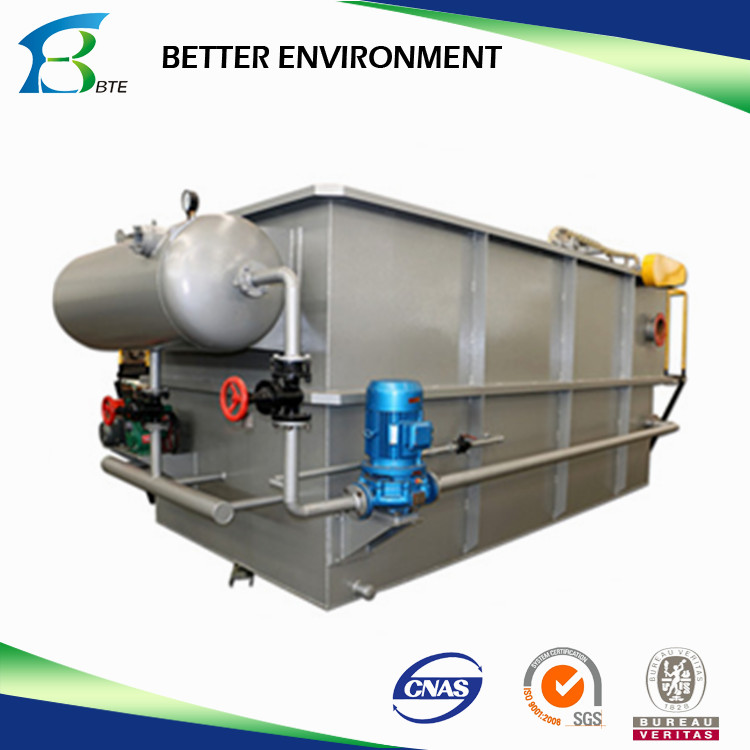
A Dissolved Air Flotation Machine is commonly considered when efficient separation of fine flocs is required.
A Cavitation Air Flotation Machine may also be considered in suitable applications depending on wastewater characteristics and plant layout.
The purpose of flotation is not to remove all dissolved color or COD.
It is to separate the pollutants that have been converted into removable solids.
After physical and chemical pretreatment, significant dissolved organic matter may remain.
Biological treatment is commonly used for the biodegradable fraction of COD and BOD.
Possible technologies include:
Activated sludge
SBR
MBBR
MBR
Anaerobic treatment
Combined anaerobic and aerobic systems
The correct system depends on:
Organic loading
Biodegradability
Salinity
Temperature
Space
Discharge requirements
Textile wastewater can be challenging for biological treatment when it contains:
High salinity
Large pH swings
Certain dyes
Surfactants
Poorly biodegradable organics
Appropriate equalization and pretreatment can help reduce these effects.
Primary and biological treatment may not always meet the final discharge target.
Additional polishing may be considered when:
Color remains too high
Refractory COD remains
Reuse is planned
More stringent discharge limits apply
Possible tertiary technologies include:
Activated carbon
Ozone
Advanced oxidation
Sand or multimedia filtration
Ultrafiltration
Membrane treatment
Reverse osmosis
These processes should not be added automatically.
They are generally selected when the final water-quality target requires them.
Chemical treatment and flotation produce sludge.
Biological treatment creates additional biological sludge.
Textile sludge may contain:
Dye residues
Pigments
Chemical flocs
Suspended solids
Biomass
Water
This sludge usually needs to be thickened and dewatered before transport or disposal.
Possible equipment includes:
Screw press
Filter press
Belt press
Centrifuge
A Sludge Dewatering Machine should therefore be considered during the original treatment design.
Dewatering helps reduce sludge volume and makes handling easier.
Air flotation is most useful when pollutants can be converted into suspended flocs.
Typical situations include:
Printing and pigment-related wastewater may contain fine solids that respond well to coagulation and flotation.
Some chemical flocs are too light to settle efficiently.
Flotation can provide a better separation route in these cases.
Textile fibers, pigments and suspended solids can often be removed before biological treatment.
If part of the COD is associated with suspended material, removing that material can reduce the load entering biological treatment.
Flotation often performs best when fine pollutants have already been destabilized and converted into larger flocs.
Both dissolved air flotation and cavitation air flotation can be used for industrial wastewater treatment.
The correct choice depends on the application.
DAF may be considered when:
Fine flocs need efficient separation
Stable clarified-water quality is important
Pressurized recycle operation is suitable
Chemical conditioning is an important part of the process
CAF may be considered when:
Simpler air-generation equipment is preferred
Wastewater contains relatively robust flocs
The plant layout is suitable for mechanically generated flotation
When choosing between DAF and CAF, consider:
Floc size
TSS concentration
Hydraulic loading
Required effluent quality
Chemical dosage
Energy use
Maintenance
Footprint
Sludge handling
Neither system should be selected based on bubble size or equipment price alone.
The wastewater should determine the choice.
Sedimentation and flotation solve similar separation problems in different ways.
Sedimentation may work well for:
Dense flocs
Easily settling solids
Biological sludge
Heavy suspended particles
Flotation is often more suitable for:
Light flocs
Fine suspended solids
Low-density pigment particles
Flocs that settle slowly
Material that tends to remain near the water surface
The correct separator depends on floc density and settling behavior.
In some plants, both technologies may be used at different treatment stages.
The treatment process should match the main wastewater problem.
Main Wastewater Problem | Recommended Treatment Focus |
|---|---|
Large fibers and lint | Screening |
Strong flow variation | Equalization |
Strong pH variation | Equalization + pH adjustment |
Suspended dye particles | Coagulation + flotation |
Light dye or chemical flocs | DAF / CAF |
High TSS | Primary solids separation |
High biodegradable COD | Biological treatment |
Poorly biodegradable COD | Consider adsorption / advanced oxidation |
High color after biology | Tertiary decolorization |
High salinity | Source control / specialized treatment |
High sludge volume | Sludge dewatering |
This table is only a starting point.
Final design should be based on representative wastewater testing.
Salt is an important challenge in many dyeing processes.
Reactive dyeing, for example, may generate wastewater with substantial dissolved salts.
This pollution behaves very differently from suspended solids.
Chemical treatment can remove particles and some color-forming material, but dissolved salts generally remain in the water.
Flotation removes suspended material.
It does not remove dissolved sodium chloride or similar salts.
Conventional biological systems may tolerate certain salinity levels, but they do not significantly remove dissolved salts.
High salinity can also affect microbial activity.
Possible strategies include:
Reducing salt use at the source
Separating high-salinity streams
Reusing suitable process water
Membrane concentration
Reverse osmosis
Evaporation or specialized zero-liquid-discharge systems where required
Salt management should therefore be treated as a separate design issue rather than expecting conventional wastewater equipment to remove it.
Textile wastewater chemistry can change significantly between batches.
A coagulant that works well for one dye may perform differently when the production recipe changes.
Chemical selection should therefore consider:
Dye type
pH
Conductivity
TSS
Surfactants
Sizing agents
Temperature
Jar testing is useful for comparing chemical combinations and dosage.
Operators should evaluate:
Floc size
Floc strength
Clarified-water color
TSS
COD reduction
Sludge volume
The goal is not simply to maximize chemical use.
The goal is stable separation at a reasonable operating cost.
Textile wastewater treatment can generate significant chemical sludge.
This material may contain concentrated:
Dyes
Pigments
Metals
Chemical coagulants
Organic matter
The disposal route should therefore follow local waste regulations.
Sludge management typically includes:
Collection → Thickening → Conditioning → Dewatering → Transport / Disposal
A treatment process should not be evaluated only by how clear the treated water looks.
Sludge quantity and disposal requirements also affect total operating cost.
A useful equipment quotation requires more than flow rate.
Important information includes:
Provide:
Average flow
Peak flow
Operating hours
Batch discharge pattern
Explain whether the plant performs:
Desizing
Scouring
Bleaching
Dyeing
Printing
Finishing
Different dyes can respond differently to treatment.
Useful parameters include:
Color
COD
BOD
TSS
pH
Temperature
Conductivity
Salinity
For retrofit projects, provide information about:
Equalization tanks
Chemical dosing
Clarifiers
Biological tanks
Existing DAF or flotation systems
Sludge equipment
Specify whether the treated water is intended for:
Sewer discharge
Direct discharge
Further treatment
Internal reuse
Space can affect whether conventional tanks, compact equipment or different flotation configurations are more suitable.
Removing visible color does not guarantee sufficient COD reduction.
Batch dyeing creates large variations in pH, temperature and pollutant concentration.
Chemical requirements can change when dye recipes change.
DAF and CAF remove suspended material, not dissolved salinity.
Suspended solids should be removed early when practical.
Some dyes and refractory organics may require additional treatment.
Ozone, membranes and other polishing technologies should solve a defined problem rather than be included automatically.
Chemical decolorization can generate substantial sludge.
Sludge handling should be included in the original system design.
Residual dyes and pigments from dyeing, washing and printing can remain in the wastewater.
Some are suspended, while others remain dissolved.
It can remove part of the color when dye-related pollutants can be destabilized and converted into separable flocs.
Performance depends on dye chemistry and treatment conditions.
DAF can remove color associated with suspended or coagulated flocs.
It is less effective for dye molecules that remain fully dissolved.
Yes, when COD is associated with suspended solids or chemical flocs.
Dissolved COD generally requires biological or advanced treatment.
Yes, for the biodegradable portion of the organic load.
However, equalization and pretreatment may be important when wastewater has large pH swings, high TSS, salinity or poorly biodegradable chemicals.
Not universally.
The correct choice depends on wastewater characteristics, floc behavior, required effluent quality, operating conditions and plant layout.
Not effectively.
Dissolved salts generally require source control or specialized separation technologies.
It may be considered when refractory COD or residual color remains after conventional treatment and stricter discharge or reuse targets apply.
Useful information includes:
Flow
Peak flow
COD
BOD
TSS
Color
pH
Temperature
Conductivity
Salinity
Dye type
Production schedule
Required discharge quality
Effective textile and dyeing wastewater treatment starts with understanding that color, TSS, COD and salinity are different treatment problems.
Equalization helps stabilize batch wastewater. pH adjustment, coagulation and flocculation can convert fine dye particles and colloidal material into separable flocs. DAF or CAF can then remove suspended solids, dye flocs and particulate COD, while biological treatment handles more of the remaining biodegradable dissolved organic load.
When residual color, refractory COD or salinity remains, additional polishing or specialized treatment may be required.
Shandong Better Environmental Protection Technology Co., Ltd. provides industrial wastewater treatment equipment and integrated solutions for textile and dyeing applications, including dissolved air flotation, cavitation air flotation, biological treatment systems and sludge dewatering equipment. System configuration can be selected according to wastewater flow, dye type, COD, TSS, color, salinity, production conditions, available space and required effluent quality.
The most effective treatment system is not the one with the most equipment. It is the one that matches each pollutant with the treatment process best suited to remove it.