| Availability: | |
|---|---|
BETTER
8421299090
The Membrane Bioreactor (MBR) Sewage Water Treatment Machine combines biological treatment with membrane filtration to provide efficient solid-liquid separation for industrial and municipal wastewater treatment. By replacing conventional secondary sedimentation tanks, the system delivers stable effluent quality while reducing the overall footprint of the treatment plant.
The membrane filtration process effectively removes suspended solids and produces high-quality treated water suitable for discharge or reuse. High biomass concentration improves the degradation of organic pollutants, enhancing treatment efficiency and system stability under varying operating conditions.
Designed with a compact, enclosed structure, the MBR system minimizes odors, reduces sludge production, and lowers maintenance requirements. It is widely used in municipal sewage treatment, industrial wastewater treatment, water recycling, and plant upgrade projects where high treatment performance and space efficiency are required.
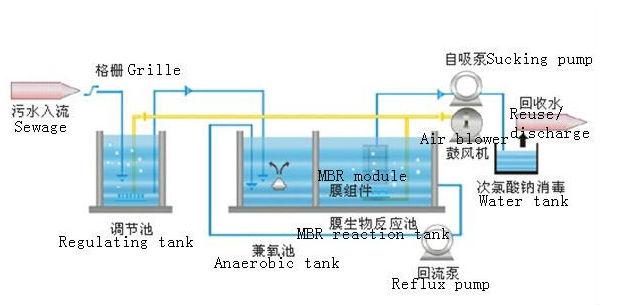
Technological Process:
Sewage → Grille → Regulating pond → MBR Bioreactor → Discharge(reuse)
1. Temperature: 5℃~45℃, average membrane aperture 0.10 μm.
2. PH: 2~12, membrane thickness: 40μm.
3. Outlet water turbidity: <1 NTU , outlet water SS <1mg/L.
4. Membrane area: 8m2, advised gas-water ratio: 25:1~30:1.
5. Operating pressure: -0.01 ~ -0.03MPa.
The MBR Sewage Water Treatment Machine combines membrane filtration and biological treatment to deliver high treatment efficiency, stable water quality, and lower operating costs for industrial and municipal wastewater treatment.
Save up to 50% Installation Space – Eliminates secondary sedimentation tanks, reducing the overall system footprint.
Stable Effluent Quality – Membrane filtration ensures consistent water quality for discharge or reuse, even under fluctuating influent conditions.
High Biological Treatment Efficiency – High MLSS concentration (<15 g/L) and long sludge retention time (<60 days) improve the removal of organic pollutants.
Lower Sludge Disposal Costs – Reduced excess sludge production minimizes sludge handling and disposal expenses.
Low Operating Costs – Low energy consumption, simple membrane cleaning, and reduced maintenance requirements help lower long-term operating costs.
Modular & Expandable Design – Flexible system configuration allows easy capacity expansion for future treatment requirements.
The MBR membrane is manufactured from high-quality PVDF material, providing excellent chemical resistance and long-term filtration performance in demanding wastewater environments.
PVDF membrane with excellent chemical resistance
High mechanical strength and long service life
Suitable for pH 2–12 and operating temperatures of 5–45°C
The membrane provides efficient solid-liquid separation, producing high-quality effluent suitable for discharge or water reuse.
Membrane pore size: 0.10 μm
Suspended solids (SS) < 1 mg/L
Low turbidity with effective bacteria removal
Hydrophilic membrane technology and optimized aeration help reduce fouling while simplifying maintenance.
Hydrophilic membrane surface reduces contamination
Air scouring minimizes membrane fouling
Supports online chemical cleaning (CIP) and air cleaning
The compact MBR system reduces installation space and can be easily integrated into new or existing treatment plants.
Saves up to 50% installation space
Modular design for easy transportation and installation
Flexible capacity expansion for future projects
The system maintains high biomass concentration to improve treatment efficiency while reducing sludge production and operating costs.
High MLSS for efficient biological treatment
Long sludge retention time (SRT)
Low energy consumption and reduced sludge disposal
Suitable for municipal and industrial wastewater treatment with stable performance under varying operating conditions.
Municipal sewage treatment
Food, chemical, and industrial wastewater
Landfill leachate and high-strength wastewater
Stable operation under fluctuating influent conditions
Selecting the right equipment provider is just as critical as the technology itself. As a dedicated manufacturer and global supplier, we offer more than just machinery; we provide comprehensive environmental partnerships tailored to your operational success.
Direct Manufacturer Accountability: By sourcing directly from our state-of-the-art manufacturing facilities, you bypass intermediaries, ensuring transparent communication, rapid customization, and highly competitive procurement economics.
Stringent Quality Assurance: Every MBR machine undergoes rigorous factory acceptance testing, pressure checks, and material verification to guarantee flawless performance upon arrival at your site.
End-to-End Engineering Support: Our team of seasoned environmental engineers provides comprehensive support, from initial CAD layout and load calculations to on-site commissioning and operator training.
Global Supply Chain Agility: We possess the logistical infrastructure to deliver heavy-duty, containerized treatment plants safely and punctually to project sites worldwide, minimizing your project downtime.
Backed by 20+ patented technologies, certified manufacturing systems, and comprehensive engineering expertise, Better delivers reliable wastewater treatment, solid-liquid separation, and waste incineration solutions for customers worldwide. Contact our experts to discuss your project today.
Mob:+86 13356363253
E-mail:sales@better-ept.com
To assist your engineering and procurement teams in their technical evaluation, we have compiled answers to the most critical operational questions regarding our MBR technology.
Q1: How does the MBR system handle fluctuating inlet water quality and sudden shock loads?
A: The system maintains an exceptionally high Mixed Liquor Suspended Solids (MLSS) concentration (up to 15 g/L). This dense, active biomass acts as a powerful biological buffer. When a shock load of high-concentration organics enters the reactor, the robust microbial community rapidly absorbs and degrades the excess pollutants, ensuring the final effluent quality remains completely stable and unaffected.
Q2: What is the expected lifespan of the PVDF membrane modules under continuous industrial use?
A: Our membranes are manufactured using a premium PVDF alloy with a reinforced inner structure. This design provides extreme mechanical strength and chemical resistance. With proper adherence to our recommended gas-water scouring ratios and routine chemical cleaning protocols, the membrane modules typically deliver a reliable operational lifespan of 5 to 7 years, even in challenging industrial wastewater environments.
Q3: Can this MBR machine be retrofitted into our existing wastewater treatment facility?
A: Absolutely. The highly modular and compact nature of our equipment makes it ideal for retrofitting. It can be seamlessly integrated into existing aeration tanks or deployed as a standalone containerized unit to instantly boost the capacity and effluent quality of an older plant, all without requiring additional land acquisition or major civil construction.
Q4: How exactly does the system achieve near-zero excess sludge emissions?
A: The MBR process completely separates the Hydraulic Retention Time (HRT) from the Sludge Retention Time (SRT). By maintaining a very long SRT (up to 60 days), the microorganisms enter a phase of endogenous respiration, where they consume cellular material to sustain themselves. This biological cannibalization drastically reduces the net yield of new sludge, cutting your sludge dewatering and disposal costs by a significant margin.
Q5: What are the specific power requirements and energy consumption metrics for this unit?
A: The system is engineered for maximum energy efficiency. The membrane suction pumps operate at a very low trans-membrane pressure (-0.01 to -0.03 MPa), requiring minimal electrical draw. Furthermore, the optimized aeration system serves a dual purpose: providing oxygen to the biomass and simultaneously scouring the membranes to prevent fouling. This synergistic design ensures the overall kilowatt-hour per cubic meter (kWh/m³) treated remains highly competitive.