Views: 0 Author: Site Editor Publish Time: 2026-10-13 Origin: Site
People often use the terms water contamination and water pollution as if they are the same. They are not. These two terms describe related but separate problems, and their causes are very different.
Contamination means any unwanted substance is in the water. Pollution means that contamination actually harms living things or the environment. A natural mineral like calcium contaminates water but does not pollute it. Industrial chemicals that poison fish cross the line into pollution.
UNEP research looked at more than 75,000 water bodies in 89 countries and found that over 40% were severely polluted. This gives a recent global estimate of water-body pollution.
Understanding pollution and water contamination helps people protect their health and choose the right treatment methods.
Table of Contents
Contamination means any unwanted substance is in water. Pollution means that substance harms living things or the environment.
Natural things like calcium can get into water without making it dirty, but chemicals made by people often cause pollution.
Point source pollution comes from one clear spot, like a pipe. Nonpoint source pollution, on the other hand, spreads out over a wide area.
Bioaccumulation causes some contaminants to collect in living tissue and get more harmful over time.
The harm threshold marks the point where contamination turns into pollution, causing real harm to living things or nature.
Testing water helps find contaminants and pollutants, so you can pick the right treatment.
Laws such as the Clean Water Act and Safe Drinking Water Act put limits on pollution and contamination to protect water.
Knowing what these words mean can help you read water quality reports and make choices that are safer for your health.
Water pollution takes place when harmful tiny living things and chemicals get into bodies of water. This makes the water quality drop and can turn the water poisonous. The term means pollution caused by human actions that hurt water quality, ecosystems, or human health. Pollution means bad biological effects, not just having a substance present.
One tiny mineral piece in a lake is not pollution. That piece only becomes pollution when it harms living things. Scientists and rule makers use this harm limit to tell pollution apart from plain contamination. The main causes of water pollution are industrial waste, sewage, oil spills, farm runoff, and radioactive waste.
The United States Environmental Protection Agency (EPA) says point source pollution is any contaminant that comes from a place that is easy to find and limited in size. Examples are smokestacks, discharge pipes, and drainage ditches. A factory that sends waste straight into a river is a classic point source of water pollution. Rule makers can trace this discharge to one pipe or outfall.
The United States Environmental Protection Agency (EPA) defines point source pollution as any contaminant that enters the environment from an easily identified and confined place. Examples include smokestacks, discharge pipes, and drainage ditches.
A nonpoint source of water pollution is the reverse. Pollutants spread out over a wide area. Runoff from a big farm field can carry fertilizer from a farm field into a nearby stream. Airborne pollutants that cause acid rain also count as nonpoint sources because they travel long distances from many factories.
Aspect | Point Source | Nonpoint Source |
|---|---|---|
Origin | A specific, identifiable location such as a pipe or outfall | Diffuse sources; difficult to trace to a single point |
Regulation | Regulated; facilities must obtain permits to discharge | Difficult to quantify and enforce; addressed through voluntary, watershed-based approaches |
Examples | Treated wastewater discharged via pipes from cities | Pet waste, irrigation, fertilizers, septic systems, grazing |
Industrial chemical pollution is one of the big groups of water pollution. Mines and factories dump harmful chemicals into freshwater systems, often without proper treatment. Marine dumping adds household trash that can take 2 to 200 years to break down. Sewage and wastewater put harmful bacteria and pathogens into the sea.
Farm runoff carries nitrates and phosphates into rivers and lakes. These nutrients cause harmful algal blooms and dead zones with no oxygen. Pesticides can build up in water species and animals higher on the food chain. Oil spills are still a major source because oil does not dissolve in water. These sources of water pollution affect human health, the environment, and the economy.
Water contamination means there is any impurity in water, no matter where it came from. The Safe Drinking Water Act defines a contaminant as any substance other than water molecules. This broad definition includes natural minerals and many compounds. Almost every natural source contains some level of impurity. Scientists use the phrase “impurities in water” to describe such additions. Calcium and magnesium occur naturally in groundwater. Their presence does not make the water unsafe to drink. But it still affects taste and treatment choices. Measuring impurity levels helps communities choose the right processing steps.
The word does not judge by itself. A contaminant or impurity may be harmless. Its presence calls for monitoring, not alarm. Many natural bodies hold substances beyond H2O. The term simply means something exists beyond pure water. Scientists keep mere presence apart from pollution that damages ecosystems. People need this difference to read tests correctly.
Water contamination can come from natural or human-made sources. Natural sources include mineral deposits, sediment, saltwater intrusion, and brackish groundwater. Human-made sources include fertilizer, household sewage, mine drainage, and industrial waste. Researchers group contaminants into chemical, biological, and radioactive types. Nitrate, for example, usually comes from fertilizer or animal waste. Toxic metals like lead and mercury come from mining or old plumbing.
Human actions can disturb natural deposits. Earthquakes and floods can wash sediment into rivers. These contaminants in streams and lakes may hurt fish, plants, and people. Each type of input needs a different way to monitor or treat. Pollution appears only when such substances really cause harm. An impurity alone does not automatically mean danger, but it does raise the chance that action is needed.
Total dissolved solids (TDS) measures all the dissolved minerals, salts, metals, and ions in water. TDS gives a general sign of water quality. It cannot identify specific substances or how toxic they are. A high TDS reading may show harmless minerals or dangerous chemicals. So choosing a purification method needs extra tests. Operators use TDS as a quick screening tool.
Turbidity measures the cloudiness caused by suspended particles like clay, silt, and plankton. Higher turbidity means more particles. These particles can shield pathogens and harbor bacteria. Removing turbidity makes disinfection work better. Low turbidity means clearer and safer water. Both TDS and turbidity are early warning signs. They show whether drinking water needs filtration or advanced treatment. Used with targeted tests, they guide the right purification strategy. Organic decay in water can raise both readings.
Not every unwanted substance in water is pollution. One grain of sand in a glass of drinking water is contamination. It is not pollution. The difference is harm. Contamination turns into pollution only when it causes real damage to living things or the environment.
Scientists and rule makers use this harm threshold to sort out water problems. A substance can stay in water at low levels for years without any bad effect. The same substance at higher levels can make fish sick, kill plants, or make people ill. The threshold depends on many things. These include the type of substance, how much is there, how long it stays, and which living things it touches.
Think about copper. Small amounts of copper are found naturally in many water sources. These amounts do not hurt most water life. But copper runoff from mining can reach levels that destroy fish gills and wreck whole ecosystems. The copper itself does not change. The harm it causes decides whether it is pollution.
This difference matters for rules. Agencies cannot treat every impurity as a crisis. They must set limits based on proven harm. That is why the Clean Water Act focuses on pollutants that damage waterways, not on every mineral that enters a stream.
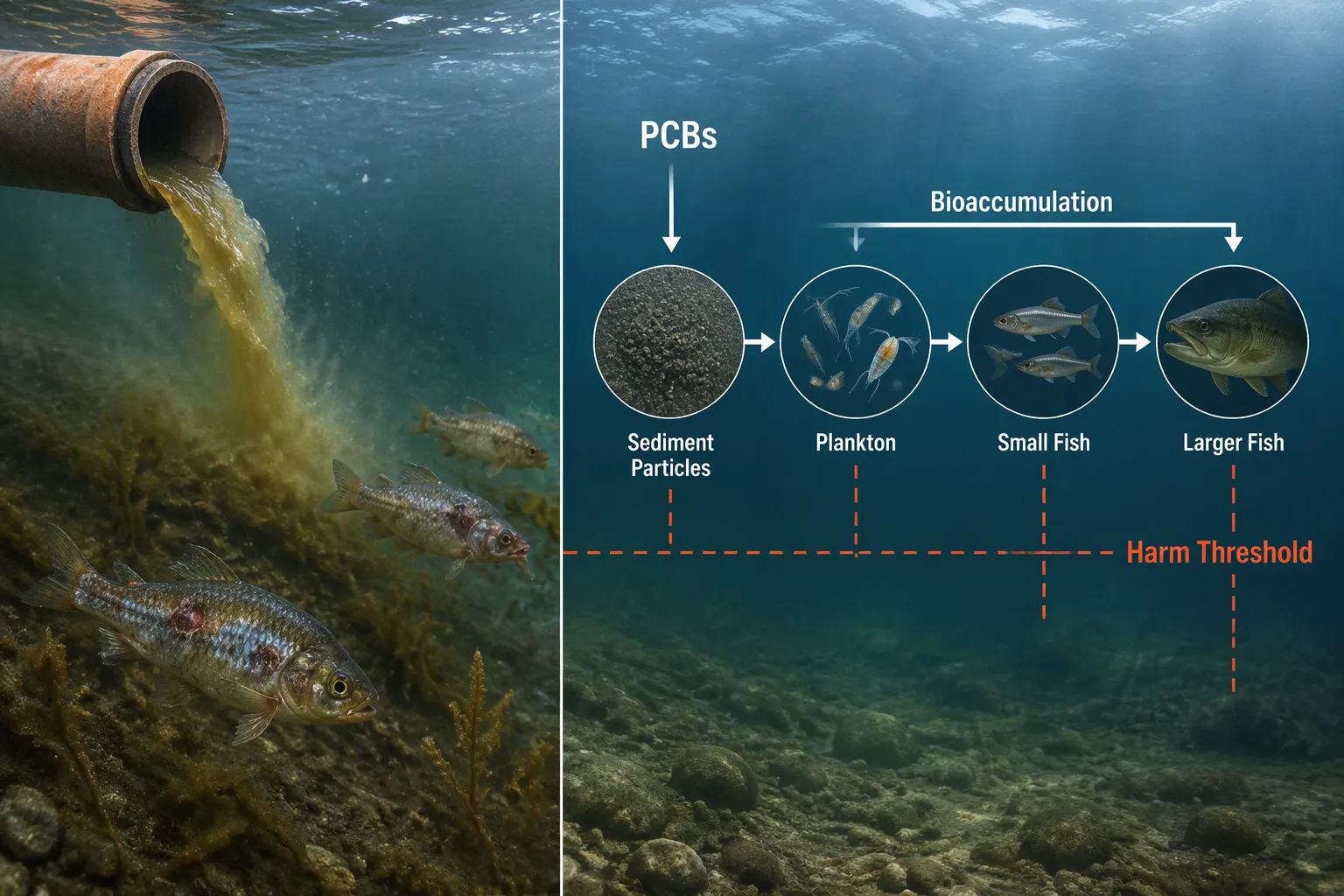
Some contaminants cause harm slowly. They build up in living tissue over time. This process is called bioaccumulation. Hydrophobic contaminants are the worst. These substances repel water and prefer to stick to fat, sediment, or living organisms.
Polychlorinated biphenyls, or PCBs, are a classic example. These industrial chemicals are hydrophobic. They do not dissolve easily in water. Instead, they cling to bits of sediment, dead organic material, or tiny organisms. These steps show how PCBs move through a food web:
PCBs stick to sediment particles and organic matter instead of dissolving in water.
Bacteria and plankton pick up these contaminated particles in the water.
Zooplankton such as krill eat the bacteria and phytoplankton, building up PCBs in their bodies.
Fish and larger organisms eat the zooplankton, moving the contaminants up the food chain.
Because PCBs resist leaving living tissue, they stay and build up at each feeding level.
Research shows that bioaccumulation factors and trophic magnification factors are above 1 for most PCBs. This means these compounds become more concentrated as they move up the food web. Not all hydrophobic contaminants act this way. Some polycyclic aromatic hydrocarbons and lower-chlorinated PCBs do not build up.
The long-term health effects of these pollutants are serious. Mercury and PCBs cause proven harm to humans and wildlife.
Pollutant | Documented Long-Term Health Effects |
|---|---|
Mercury | Neurological damage; Minamata disease; proteinuria; hypertension; developmental disorders and cognitive impairments (especially in children and unborn children); central nervous system damage; in severe cases irreversible brain damage; milder cases include reduced motor skills and dulled senses of touch, taste, and sight |
PCBs | Immune system dysfunction; thyroid disease; certain cancers |
Heavy metals (general) | Neurological damage; kidney dysfunction; developmental issues in children |
Methylmercury affects the central nervous system, and in severe cases irreversibly damages areas of the brain. The most well documented cases of severe methylmercury poisoning are from Minamata Bay, Japan in 1956 and in Iraq in 1971. In each case, hundreds of people died, and thousands were affected, many with permanent damage. In milder cases of mercury poisoning, adults complain of reductions in motor skills and dulled senses of touch, taste, and sight. These milder effects are generally reversible if exposure to mercury is halted. Unborn children are at greatest risk from low-level exposure to methylmercury. Recent research suggests that prenatal effects occur at intake levels 5-10 times lower than that of adults.
The line between contamination and pollution shapes how societies classify and control water quality. A community may find arsenic in its wells. That finding is contamination. If the arsenic levels go above safe limits and threaten human health, the situation becomes pollution. The response changes at that point. Cleanup requirements, health warnings, and legal penalties may follow.
This difference also guides treatment decisions. Removing harmless minerals from water is optional. Removing toxic pollutants is mandatory. Treatment systems must match the specific problem. A filter that removes sediment will not remove dissolved mercury. An activated carbon system that captures organic chemicals will not fix high salt levels.
Regulators use the harm threshold to set priorities. They send limited resources toward the most dangerous problems. This approach protects public health without wasting money on minor impurities. For anyone worried about their own water supply, understanding this difference helps them ask the right questions and choose the right solutions.
Scientists use chemical and biological tests to find pollutants in water. Chemical tests use gas chromatography-mass spectrometry to find volatile organic compounds. High-performance liquid chromatography checks for pesticides and pharmaceuticals. Spectrophotometry finds nitrate and phosphate by measuring how much light they absorb. Heavy metals analysis finds arsenic and lead, which harm organs and cause developmental problems.
Biological tests focus on living organisms. Coliform bacteria testing finds total and fecal coliforms as signs of human or animal waste. Polymerase chain reaction copies genetic material from specific pathogens. Immunoassays use antibodies for quick screening at treatment plants. The Microtox assay uses bioluminescent bacteria for general toxicity screening. These methods help find pollution sources, including point source discharges from factories.
Contaminant testing measures physical properties and specific substances. Turbidity testing checks how cloudy water is from suspended particles. Total dissolved solids meters measure dissolved minerals and salts. These tests give early warning signs without identifying specific compounds.
Advanced methods find trace contaminants. EPA Method 537.1 uses solid phase extraction and liquid chromatography-tandem mass spectrometry to measure 18 PFAS compounds in drinking water. EPA Method 546 uses enzyme-linked immunosorbent assay for total microcystins. Labs also test for radiological contaminants near mining or nuclear facilities. Each test targets different contaminant types, so water systems pick methods based on local risks.
Consumer Confidence Reports help people understand their water quality. These reports must list detected contaminant levels and the range of detected levels. For lead and copper, the report shows the 90th percentile value and the number of sites above the action level. For turbidity, the report lists the highest single measurement and the lowest monthly percentage of samples meeting limits.
The report also names likely sources of detected contaminants. It sums up the system's susceptibility to potential contamination sources based on source water assessments. If monitoring shows Cryptosporidium may be present, the report includes those results and what they mean. Readers should check the detection date, contaminant levels against acceptable limits, and any noted health effects. This information helps people understand whether their water has contamination or pollution and what treatment may be needed.
Since contamination does not always cause harm, treatment systems must fit the exact problem. Some impurities are harmless. Others cause real harm. The right approach starts by finding out what is in the water and measuring whether it reaches dangerous levels.
Normal treatment mixes physical removal with chemical neutralization. Screens and grit chambers remove large particles first. Sedimentation tanks or dissolved air flotation remove suspended solids, fats, oils, and grease. Coagulation and flocculation pull out fine particles and heavy metals. Biological treatment breaks down organic material. Tertiary steps add filtration, disinfection, reverse osmosis, or membranes for the smallest contaminants.
Focus | Standard method |
|---|---|
Removal | Screening, grit chambers, sedimentation, dissolved air flotation |
Removal | Coagulation and flocculation |
Removal | Secondary biological treatment |
Removal | Tertiary filtration, disinfection, reverse osmosis |
Neutralization | pH adjustment and chemical neutralization |
For point-of-use systems, reverse osmosis rejects dissolved salts, arsenic, fluoride, and total dissolved solids. Activated carbon removes chlorine, taste, odor compounds, and many organic chemicals, but not hardness minerals. Ultraviolet disinfection inactivates bacteria, viruses, and protozoa. Cloudy water reduces UV performance, so operators should clarify the water first.
Shandong Better Environmental Protection Equipment Manufacturer provides customized wastewater treatment solutions for municipal, medical, and industrial clients. Since 2006, the company has offered compact urban sewage plants, underground systems, and MBR sewage treatment equipment. Industrial water filters, such as 750 L/h units, handle smaller streams.
Sludge dewatering systems complete the lineup. Centrifugal decanters, screw press filters, and automatic decanter centrifuges reduce sludge volume. Lamellar clarifiers, rotary drum filters, micro bubble generators, and chlorine dioxide generators cover clarification, aeration, and disinfection. Engineers design each process around water quality characteristics and discharge standards. The company also provides installation guidance, commissioning, and maintenance training.
The choice depends on the source. Municipal wastewater from homes contains organic waste, suspended solids, nutrients, pathogens, and fats, oils, and grease. Industrial wastewater can include oils, solvents, heavy metals, high salinity, extreme pH, and persistent compounds such as PFAS. For a household drinking water system, activated carbon and UV may handle common issues. For a factory, a multi-stage line is necessary.
Contaminant type, concentration, and mass loading determine system size and technology. Water quality parameters like pH and hardness influence performance, so pretreatment may be required. Regulatory limits set the minimum standard. Space, power supply, and budget shape the final decision. Seasonal changes affect influent quality, so flexible systems work best. Without accurate testing, a system can miss the real problem.
The Clean Water Act (CWA) focuses on water pollution in surface waters like rivers, lakes, and streams. It makes it illegal to release any pollutant from a point source into navigable waters without a permit. Point sources are specific pathways such as pipes, ditches, or channels. The law defines "clean" water by setting water-quality rules that separate safe conditions from harmful pollution levels. These rules cover temperature, oxygen, and certain chemicals.
The CWA uses the National Pollutant Discharge Elimination System (NPDES) permit program to control discharges. Permits limit pollution levels, require monitoring and reporting, and last no more than five years before renewal. Facilities must follow the stricter limit between numerical pollutant caps and best-available-technology requirements. For waters that already meet standards, anti-degradation policies stop new pollution sources from lowering quality.
The Safe Drinking Water Act (SDWA) protects drinking water quality in the United States. It applies to waters actually or potentially meant for drinking use, whether from above-ground or underground sources. The law allows the EPA to set minimum standards for tap water. It requires owners or operators of public water systems to meet health-related standards.
The SDWA sets maximum contaminant levels (MCLs) as legal limits for substances in public water systems. An MCL is usually shown as a concentration in milligrams or micrograms per liter of water. To set an MCL, the EPA first finds the maximum contaminant level goal, a non-enforceable public health goal. The legally enforced MCL is then set as close as possible to that goal. As of 2019, the EPA has issued 88 standards for microorganisms, chemicals, and radionuclides.
Law | Primary Focus | Regulated Water Type | Regulatory Approach |
|---|---|---|---|
Clean Water Act (CWA) | Addresses pollution of surface waters such as rivers and lakes | Surface waters | Regulates pollutant discharges from industrial, municipal, and agricultural sources; uses water quality standards, permits, and enforcement |
Safe Drinking Water Act (SDWA) | Ensures safety of drinking water | Drinking water sources, including above-ground and underground waters intended or potentially intended for drinking | Sets maximum contaminant levels and oversees public water systems to protect human health |
The EPA enforces the CWA, though it may give regulatory and enforcement authority to states, tribes, and territories. For impaired water bodies not meeting standards, states and the EPA establish Total Maximum Daily Loads (TMDLs). A TMDL sets the most pollutant a water body can receive while still meeting water quality standards. Permit holders must send Discharge Monitoring Reports regularly and keep records for at least three years.
Under the SDWA, states can be approved to carry out rules for the EPA. The EPA may issue penalty orders for violations, with penalties up to $48,586 per day per violation. Citizens may also file civil actions against federal agencies in violation of SDWA requirements. Both laws work together to protect water resources from contamination and harmful pollution.
Water pollution is a human-caused kind of water contamination. Contamination is the larger group. It covers natural impurities, like calcium and sediment. A substance becomes pollution only when it really harms living things or the environment.
Both issues lower water quality. They also guide which treatments are needed. A sediment filter cannot remove dissolved mercury. People should use these terms correctly. They should also look at local water quality reports. These reports tell what is in the water and if it is a health risk. Using clear terms helps people choose safer water and proper treatment.
No. Contamination means any unwanted substance is in the water. Pollution means that substance causes real harm to living things or the environment. A harmless mineral like calcium contaminates water without polluting it. The harm threshold separates the two terms.
Yes. Natural substances become pollutants when they reach harmful levels. Copper occurs naturally in many water sources at low amounts. Copper runoff from mining can reach concentrations that destroy fish gills and damage whole ecosystems. The substance stays the same, but the harm it causes changes its classification.
The two terms describe different problems with different responses. Contamination calls for monitoring and testing. Pollution triggers cleanup requirements, health warnings, and legal penalties. This distinction helps regulators send limited resources toward the most dangerous problems and protects public health without wasting money on minor impurities.
Not necessarily. Total dissolved solids measures all dissolved minerals, salts, metals, and ions in water. A high TDS reading may show harmless minerals or dangerous chemicals. TDS works as a quick screening tool, but it cannot identify specific substances or how toxic they are. Extra tests are needed.
Some contaminants build up in living tissue over time. This process is called bioaccumulation. Hydrophobic contaminants like PCBs repel water and stick to fat, sediment, or living organisms. These substances become more concentrated as they move up the food web. The harm grows at each feeding level.
Point source pollution comes from a place that is easy to find and limited in size, such as a discharge pipe or drainage ditch. Nonpoint source pollution spreads out over a wide area, like fertilizer runoff from a big farm field. Regulators can trace point sources to one outfall, but nonpoint sources are difficult to quantify and enforce.
The Clean Water Act targets pollution in surface waters like rivers and lakes. It regulates pollutant discharges from industrial, municipal, and agricultural sources. The Safe Drinking Water Act protects drinking water quality by setting maximum contaminant levels for public water systems. Both laws work together to protect water resources.
Check your local water quality report, called a Consumer Confidence Report. These reports list detected contaminant levels, likely sources, and any noted health effects. Compare the levels against acceptable limits. This information helps you understand whether your water has contamination or pollution and what treatment may be needed.